Problems identified
In our survay we found some of the major problems that are facing by students, we collected this information from various schools from our loucation and in this page you can know about the following content.
1.Classroom Size
2.Poverty
3.Family Factors
4.Technology
5.Bullying
6.Student Attitudes and Behaviours
7.No Child Left Behind
8.Parent Involvement
9.Suicide
10.drugs
11.dropping out
12.Making New Friends
13.Adjusting To New Expectations
14.Understanding New Procedure
15.Lack of motivation
16.absence of preparation and effort
17.poor time management
Short and long term action plans for problems identified
How to Improve Education System
As classroom size increases, this becomes increasingly difficult to do. Overcrowding increases classroom discipline issues. Large classes packed with students provide more opportunities for personality conflicts, tension, and general disruptive behavior
Class size is one of the small number of variables in American K-12 education that are both thought to influence student learning and are subject to legislative action. Legislative mandates on maximum class size have been very popular at the state level. In recent decades, at least 24 states have mandated or incentivized class-size reduction (CSR).
The current fiscal environment has forced states and districts to rethink their CSR policies given the high cost of maintaining small classes. For example, increasing the pupil/teacher ratio in the U.S. by one student would save at least $12 billion per year in teacher salary costs alone, which is roughly equivalent to the outlays of Title I of the Elementary and Secondary Education Act, the federal government’s largest single K-12 education program.
The substantial expenditures required to sustain smaller classes are justified by the belief that smaller classes increase student learning. We examine “what the research says” about whether class-size reduction has a positive impact on student learning and, if it does, by how much, for whom, and under what circumstances. Despite there being a large literature on class-size effects on academic achievement, only a few studies are of high enough quality and sufficiently relevant to be given credence as a basis for legislative action.
The most influential and credible study of CSR is the Student Teacher Achievement Ratio, or STAR, study which was conducted in Tennessee during the late 1980s. In this study, students and teachers were randomly assigned to a small class, with an average of 15 students, or a regular class, with an average of 22 students. This large reduction in class size (7 students, or 32 percent) was found to increase student achievement by an amount equivalent to about 3 additional months of schooling four years later.
Studies of class size in Texas and Israel also found benefits of smaller classes, although the gains associated with smaller classes were smaller in magnitude than those in the Tennessee STAR study. Other rigorous studies have found mixed effects in California and in other countries, and no effects in Florida and Connecticut.
Because the pool of credible studies is small and the individual studies differ in the setting, method, grades, and magnitude of class size variation that is studied, conclusions have to be tentative. But it appears that very large class-size reductions, on the order of magnitude of 7-10 fewer students per class, can have significant long-term effects on student achievement and other meaningful outcomes. These effects seem to be largest when introduced in the earliest grades, and for students from less advantaged family backgrounds.
When school finances are limited, the cost-benefit test any educational policy must pass is not “Does this policy have any positive effect?” but rather “Is this policy the most productive use of these educational dollars?” Assuming even the largest class-size effects, such as the STAR results, class-size mandates must still be considered in the context of alternative uses of tax dollars for education. There is no research from the U.S. that directly compares CSR to specific alternative investments, but one careful analysis of several educational interventions found CSR to be the least cost effective of those studied.
The popularity of class-size reduction may make it difficult for policymakers to increase class size across the board in order to sustain other investments in education during a period of budget reductions. In that context, state policymakers should consider targeting CSR at students who have been shown to benefit the most: disadvantaged students in the early grades, or providing a certain amount of funding for CSR but leaving it up to local school leaders on how to distribute it.
In settings where state mandates on maximum class size are relaxed, policymakers need to bear in mind that the effect of any increase in class size will depend on how such an increase is implemented. For example, a one-student increase in the pupil/teacher ratio in the U.S. would reduce the teaching workforce by about 7 percent. If the teachers to be laid off were chosen in a way largely unrelated to their effectiveness, such as seniority-based layoffs, then the associated increase in class size might well have a negative effect on student achievement. But if schools choose the least effective teachers to let go, then the effect of increased teacher quality could make up for some or all of the possible negative impact of increasing class size.
State resources for education should always be carefully allocated, but the need to judiciously weigh costs and benefits is particularly salient in times of austere budgets. Class-size reduction has been shown to work for some students in some grades in some states and countries, but its impact has been found to be mixed or not discernable in other settings and circumstances that seem similar. It is very expensive. The costs and benefits of class-size mandates need to be carefully weighed against all of the alternatives when difficult decisions must be made.
“Young children growing up in poverty face challenges with cognitive and literary ability and [often] begin school both academically and socioeconomically behind their peers from higher-income backgrounds.”
A study in 2002 found that these conditions in India are partially due to educational poverty, which is defined as the deprivation of basic education and literacy. Only 6% of the income from poor households is invested into education and health, while the majority is spent on other necessities such as food and fuel.The word ‘Poverty’ tends to conjure up a variety of images,a variety of ideas and opinions in all of us, some based on stereotypes, some based on media and television and some based on our own life experiences and with different kinds of negative perspectives. The effects of poverty are more than just missing a meal. Families struggle with chronic food insecurity, hunger, and malnutrition. When families don’t have the food, their health and livelihood suffers,the long course of poverty takes a toll on them,in a vicious cycle that affects one generation after another.Poverty effects all of the population in one or the other way and we all are caught in it like the prisoners in the jails.The condition becomes worthy and ill, the life in dissatisfaction shows dominance. Poverty is not having enough material possessions or income for a person’s needs. Poverty may include social, economic, and political elements as well.
United Nations as neatly defined Poverty as,the inability of having choices and opportunities, a violation of human dignity. It means lack of basic capacity to participate effectively in society. It means not having enough to feed and clothe a family, not having a school or clinic to go to, not having the land on which to grow one’s food or a job to earn one’s living, not having access to credit. It means insecurity, powerlessness and exclusion of individuals, households and communities. It means susceptibility to violence, and it often implies living in marginal or fragile environments, without access to clean water or sanitation.
The poverty, most of all affects the children, affects the students through different modes of their education and mental course of health.Its main impact is seen on the students, upon the education. The student from a poorer background gets highly affected, both with disappointment and irresponsible treatment everywhere. Humiliation, exploitation, indignity, inequality, a feary environment they get at every place whether college or secondary school level .The financially worse situation takes a toll on a good student.
One of the biggest lessons we are taught as children is that we need to stay in school. Having an education is the first step to finding a job, earning money and to make life successful and happy. Without an education, many are left jobless and stuck living in poverty for the rest of their lives, that degrades our level and a good student gets off the mark. It is a fact that statistics show that for children who live below the poverty line, the chances of having school success is much lower than their other peers .Coming on poverty, Children living in poverty often get exposed to more stress, more intense & longer lasting stress that negatively impact attention, lowers fitness and focus, cognition, intelligence quotient(IQ) and social skills. Children living in poverty also tend to hear less reciprocal conversations, are engaged in conversation with less complex vocabulary and less sentence structure, and are read to less frequently than their peers not living in poverty.
This can lead to severe mental conditions that impact a student’s motivation and desire to do well in school.
A study by the ”Crittenton Women’s Union” says that, ‘When a person lives in poverty, the limbic system is constantly sending fear and stress messages to the prefrontal cortex, which overloads its ability to solve problems, to solve mathematical science, set goals, to deal with extreme situations and complete tasks in the most efficient ways’. These students will continue to be behind. The low-income children are many a times more likely to drop out when they reach high school. In fact all possible consequences of poverty have an impact on children. Poor infrastructures, unemployment, lack of basic services and income reflect on their lack of education, malnutrition, violence at home and outside, child labour, diseases of all kinds, transmitted by the family or through the environment. Indeed, poverty had long lasting and much regressive impacts on education.
The impact of poverty on a child’s academic achievement is significant and starts early,” says Jonah Edelman, PhD, co-founder and chief executive officer of Stand for Children, a non-profit education advocacy organization. “Young children growing up in poverty face challenges with cognitive and literary ability and [often] begin school both academically and socioeconomically behind their peers from higher-income backgrounds.”
These students do not possess even good foundation of education ability and college, for the most part, isn’t on their agenda. For those who do manage to go to college, they are on an average, ill-prepared for the journey. Their poor academic preparation handicaps them the entire way, as do poor time management and study skills
One cannot dismiss the financial pressures facing these students as well, Even for those who receive full Pell Grants and some institutional aid, that rarely provides enough to cover their needs, and their families typically do not have the wherewithal to help.
Impacts on mental health.
Not only education, every sphere of life gets affected by the poverty discourse. Poverty is the main cause and consequence of poor ill health. It is obvious, poverty is linked with negative conditions such as substandard housing, homelessness, inadequate nutrition facilities and food insecurity, inadequate child care or lack of access to health care and under resourced schools which adversely shows its impact on our children. Poverty in adulthood is linked to depressive and serious disorders, anxiety disorders, psychological distress, and suicide. Poverty affects mental health through an array of social and biological mechanisms acting at multiple levels, including individuals, families and friends. Growing up growing up in poverty often exposes children to greater levels of stress, which can lead to psychological problems later in life, Researchers at Cornell University reported that ”kids who grow up poor are more likely to have reduced short-term spatial memory.”
Family-related factors, like parent's educational level, their values and expectations have a significant impact on child's early skills and later educational outcomes. Further, parents provide their child, alongside with other learning environments, a broad mathematical and early literacy input.
How does the size of family affect education?
One of the important ways in which high fertility affects economic development is through educational attainment of children. Children from larger families have less education and poor health because parents are financially constrained by having to invest in the education and health of each child
What is the role of family in education?
Family is a quintessential part of a child's education. Providing a happy and positive growing environment has proven to be extremely beneficial in bettering the child's mindset and cognitive mind. It is one of the primary roles of parents to ensure that a happy learning environment is provided to a growing child.
How does family background affect students?
Image result for how do family factors affect education
Family background and children's learning behavior
The higher the family's socioeconomic status, the lower the enthusiasms for learning the children have. Parental education participation has a significant positive effect on children's learning behavior.
Family as the basic unit of society plays a big role in the educational aspect of their family members. Although problems are inevitable inability to manage it may affect the behavior and the academic performance of the students. This study aimed to determine the effects of Family Problems to the academic performance of Grade 12 HUMSS Students in Bestlink College of the Philippines. This study will really help student to overcome their Family Problems and can identified what issues that they are facing right now. The researchers used Qualitative method and Descriptive Research Resign to obtain general overview of the topic that pertain to the impact of family problems in the academic performance of Grade 12 students. Survey Questionnaire was used to gather information needed to discuss the topic. Cluster sampling technique has been conducted in choosing the respondents. The study found out that family problems seriously affect the performance of the students in particular to their attendance and performance. Family problems that involve financial difficulties, relationship and bad habits are the contributing factors in the performance of the students. Lack of financial support impacts the student’s attendance and compliance with the school projects and activities. Students choose not to attend the class than to stay hunger one day in school. Family relationship on the other hand, impacts the student’s emotional level. It impacts to their focus in class. Wrong culture of the family brings out bad behavior and habit to the students. Family problems are inevitable and creates a big impact to the academic performances of the students. This awareness may help the teachers and parents to help the students who are encountering serious family problems to pursue their students despite those family issues and challenges. They have to develop a positive spirit and positive response in life.
Impacts of technology on Education are the following:
Easy access to information; easy retention of information, more storage of information, better presentation of information, teaching became more interactive, easy sharing of knowledge and more interest in learning.
The field of education (teaching and learning) has revolutionized since the advent of technology. Schools have realized the importance of technology and have started implementing it in the classrooms. With the arrival of computers in schools, it has become easier for teachers to impart knowledge and for the students to acquire it. The onset of technology has made the journey of teaching and learning more effective.
Technology is a teaching tool
Computers provide us with an interactive audio-visual medium. Animation software and Power Point presentations are used to present information in an interactive way. Both teachers and students find it helpful and interesting to use audio-visual tools. Large number of students can be addressed simultaneously with the help of projectors, screens, microphones and speakers. These teaching aids have led to increased attendance in classes.
Technology has made student life easy
Technology has made the life of students easier. Nowadays, students use different software and tools to make presentations and projects, instead of using pen and paper. An iPad is very light as compared to a pile of notebooks. Surfing an E book is easier as compared to a heavy book. These tools help to generate more interest in studies. There are online libraries which require no physical space. The teachers, students and researchers sitting in different parts of the world can access the same online library simultaneously.
Easy to store information
Due to technology, data storage has become much easier. It takes few seconds to type or copy-paste various information. A small pen drive can store huge amount of information. So, managing records online is easier. Computers enable better and strong storage of data as compared to managing hard copies.
Digital classrooms
Both students and teachers get benefited through the use of digitized boards in classrooms. Thanks to the advanced technology that we can see the entire syllabus online and then decide which courses and subjects we should opt for. Interactive digitized boards can be used by students for drawing figures, making diagrams, doing mathematical calculations, etc.
Information is easily accessible
The internet search engines are a source of immense information. They are now used as an effective tool for searching information. All this is possible in just one or two clicks. Both teachers and students are benefited through this.
Wikipedia is the ideal example, around ten years ago, it didn’t even exist. Now, it is by far the world’s largest encyclopedia. It has around 2.5 million entries: instantly available free, on the Web. All are contributed free by more than 75,000 volunteers. Wikipedia provides an excellent platform for cooperative sharing.
Teaching is sharing
The application of technology has made education more collaborative. There are online forums where subject experts can meet and discuss subject specific topics, review the syllabus and plan assessments to enhance the process of teaching. Teachers can impart customized education to cater different learning abilities and needs of the students. Everyone has a personal learning style, almost as unique as one’s fingerprints. Any skills can now be taught online in sequence, from beginner level to master level. Good teachers and multimedia experts can tailor such instant learning programs to individual learning styles and in individual modules.
Technology has removed space and time limitations
There are different online education programs available which has given a new dimension to education. The students and teachers can be a part of one virtual classroom, even if they are physically far away from each other. Some universities offer online educational programs where students and teachers can interact with each other through internet. There are online libraries with books, journals, encyclopedias, etc. where students can access various resources, highlight, save and use the soft copies.
And universities almost everywhere now offer online degrees. The private university of Phoenix is now America’s biggest university, with 280,000 students, 239 campuses and offshoots around the world. In the early 1990s, it became the first U.S. University to offer degrees online.
In today’s fast changing world, most of the jobs involve the use of computers and advanced technologies. We all need to be computer savvy to keep in pace with the moving world. We live in a technologically advanced world where it has become necessary for us to be familiar with the latest technologies and inventions. So, computer technology has become an integral part of school and college curriculum.
Negative effects
Lower attention span. Teachers, parents, and students themselves find that technology can have a direct impact on attention spans. The immediacy of technological interactions make waiting harder for children. With technology, they aren’t forced to wait. They can have their TV show immediately, they don’t get bored because they always have something to entertain them. Technology moves fast, instant responses and instant gratification are impacting attention spans for young children and teenagers alike.
Increased risk and lack of privacy. Teenagers and children have grown up in a technological world, and the idea of privacy is somewhat foreign to them. Cybersecurity is a huge element of tech today, but it isn’t always perfect. Hackers and criminals can utilize technology to steal identities and harass children. Technology has created an increase of theft, privacy issues, harassment, and more. The IT industry is in need of cybersecurity professionals who can help make technology more safe for children, so consider getting started on your degree today.
Risk of depression. Teenagers and children who report more time using media are more likely to also report mental health issues. Depression is a key issue that is correlated with more media use. This has increased suicide rates and has lead to more youth needing mental health interventions like medicine and counseling. Experts believe time spent on social media or using technology can directly be tied to increased depression.
Obesity. Children who spend more time inside on their phones or tablets don’t spend as much time running and playing outside. They establish habits of technology use that doesn’t involve exercise. This can lead to increased obesity rates in children and young adults.
Falling grades. Many students today can see their grades take a hit when they spend more time with technology. Increasing technology usage means less time spent on homework, and the kind of developmental changes technology can bring can make students struggle with homework like reading and writing.
Bullying. As technology flourishes, so does bullying. Children and teens are using technology and social media to bully other kids, without having to face them. Often called cyberbullying, this trend is increasing and getting more popular with even younger students.
Social interaction issues. With more time spent on technology, younger children are having issues with face-to-face social interactions. Many seem to prefer to text or talk on social media as opposed to talking to each other in-person. Even when children spend time together, they may spend more time texting or on their phones than actually being together.
Causes of Bullying
The causes for bullying are varied, meaning any student can become a target, regardless of gender, race, religion, or socioeconomic status.
Understanding why students bully others can help teachers better combat it. Factors that can lead to bullying include differences in appearance, social status, race, and sexual orientation. The National Center for Educational Statistics found that 25% of African American students were bullied in 2016, while 22% of Caucasian students, 17% of Hispanic students, and 9% of Asian students were.
Some students who bully others have low self-esteem; however, there are others that have much higher self-confidence. Those with high self-confidence tend to lack compassion and empathy and can respond aggressively whenever they feel threatened.
Current societal events and conversations can compound bullying problems. As an example, bullying based on sexual orientation has increased as the conversations surrounding LGBTQIA (lesbian, gay, bisexual, transgender, queer, intersex, asexual) have increased in recent years.
In some cases, students' need for attention and the desire to be perceived as brave and confident can cause them to bully. Students who experience issues at home, such as abuse and neglect or a divorce, can cause them to bully others due to despair, anger, or jealousy.
Effects of Bullying
Bullying during formative school years can have long-lasting effects. Students who are bullied may have poor academic performance as their interest and participation in school decreases, and unexplained injuries and self-destructive behavior can occur. A 2016 National Center for Educational Statistics survey reveals that 14% of bullied students struggle academically.
Emotional effects include struggles with low self-esteem, insomnia, depression, and suicidal thoughts and actions. In addition, students who are bullied are twice as likely to suffer from health problems, such as stomach issues or headaches.
Bullying does not only impact the students, but also their family and classmates. Feeling powerless and confused, parents and other family members of bullying targets may experience depression, anxiety, and stress-related illnesses. Some parents become overprotective of their children if they feel they "failed" to protect them. Friends and classmates of the student who is bullied may feel powerless to help, guilt over not standing up for the target, and fearful of becoming the next target.
What is the effect of cyberbullying in academic performance?
Effect of cyberbullying on academic performance
Being a victim of cyberbullying also affected students' grades. About 41% of the victims confirmed that they became less active in class, 24% confirmed that their school performance had dropped and 35% had repeated a grade since becoming victims of cyberbullying
What is the attitude and behavior of a student?
Image result for student attitudes and behaviors problems
A student's attitude is their tendency to respond a certain way towards something. Naturally, the student's response can be on a continuum of positive to negative or good to bad.
Therefore, students' attitudes change in their learning process either directly or indirectly through observation, experiences, and the learning environment. Hence the change in attitude is mostly influenced by teachers, parents, peers' characteristics, and classroom environment
A positive attitude lets you relax, remember, focus and absorb information as you learn. You’re ready to welcome new experiences and recognize many different kinds of learning opportunities. And when you can see opportunities, hope increases.
Take Eileen, for example. Eileen has recently enrolled in college, even though it's been 20 years since she wrote a paper or studied for an exam. However, in the 15 years that she has stayed home to raise her children, Eileen has mastered stress and time management skills, teamwork skills, budgeting skills and more. She has developed online skills, read a lot, chaired community committees and coached several soccer teams. Based on her experience, she knows she can polish up her report writing and study skills and do well in her program
There is no guarantee that you will instantly be able to understand mathematics through eliminating a
negative attitude about math. A less inhibiting attitude like "in the past I may have not done well at
math, but I can still learn to do math and earn better grades in the future," removes self-imposed limits.
This more positive attitude creates the opportunity for learning and motivation that leads to success in
math regardless of past performance. By changing this negative attitude into a positive one, the door is
opened to the possibility of not only learning math but becoming superior at it, regardless of past
performance. Positive attitudes combat frustration from self-imposed limits on your potential to
change through learning.
The basic premise underlying any teaching is that the pupil has the capacity to learn and change and
wants these things to happen regardless of past performance. Negative attitudes discourage, limit, and
even prevent learning, positive change, and growth. What are your attitudes about learning, teachers,
One of the most serious criticisms of No Child Left Behind is an issue of funding and unfunded mandates. Critics say that education funding is not a high priority in the United States, with many schools finding their budgets cut repeatedly year after year.
The No Child Left Behind Act (NCLB) is a controversial piece of legislation passed in the United States in 2001 to fulfill President George W. Bush's promises of sweeping educational reform. Many Americans agree that the public education system is in need of drastic changes so that American children can be better served. However, some Americans feel that the legislation was not a productive response to the problem. Many classroom teachers, educational activists, and advocates for alternative education have spoken out against NCLB.
One of the most serious criticisms of No Child Left Behind is an issue of funding and unfunded mandates. Critics say that education funding is not a high priority in the United States, with many schools finding their budgets cut repeatedly year after year. This makes it difficult to purchase textbooks, let alone implement policies required. Many teachers or potential teachers who can offer excellent instruction are often reluctant to enter the public school system, which is notorious - especially in urban areas - for having decaying facilities and low compensation for teachers. In especially poor districts, teachers are sometimes forced to purchase classroom supplies out of pocket if they want their students to have access to art supplies, paper, and other educational tools. The strict requirements of NCLB can be a financial drain on schools and districts already strapped for cash.
Many critics of No Child Left Behind also argue strongly against the use of standardized testing to evaluate school progress. Studies have shown that some students simply perform better on standardized tests than others, and that good performance on testing does not necessarily reflect a higher quality education, especially when many classroom teachers feel pressured to “teach to the test” in order to ensure good scores for their school district. Furthermore, some school districts may feel tempted to stack the deck in their favor by excluding students whom they know will perform badly, such as the developmentally disabled and English as a Second Language students. Also, because the tests are set on a state by state basis, individual states have the ability to manipulate the material on them to make test taking easier for their students, making them an invalid measure of progress and abilities. Opponents of NCLB also point out that the standardized tests are thought to have cultural and linguistic biases; including testing recently immigrated non-English speaking students in English.
If a school is determined to be "failing" under the NCLB standards, sanctions are imposed on the school. Many organizations including the American Federation of Teachers believe that these sanctions are not a helpful way to address failing schools, because they are viewed as penalizing, rather than supportive. Some of the sanctions are sensible; for example, when a school is identified as in need of improvement, a school improvement plan is developed as a cooperative effort between parents, teachers, administrators, and the department of education. This improvement plan must clearly address the ways in
However, many of these sanctions are perceived as punitive, and potentially harmful to the troubled school district. Parents with children in schools undergoing sanctions are allowed to transfer them to another district, and the failing district is required to pay for transportation costs to the new school. Furthermore, while the sanctions include measures like providing extra assistance to students in need of it, this assistance must fall within guidelines which some teachers feel are very narrow, because No Child Left Behind places a heavy emphasis on specific scientific research. While some students may be well-served by the services that schools can offer them under this legislation, many teachers wish to be able to offer a wider range of assistance, even if this help includes non-conventional educational approaches.which the school intends to rectify the situation.
Some critics also believe that the requirements for corrective action are too restrictive. These requirements include firing “school staff relevant to the failure,” according to the Department of Education, along with restructuring school management, bringing in educational professionals from outside the school district, and creating a new curriculum. If a school continues to struggle, it may be closed, or reopened under new management, often under an umbrella corporation that offers educational services to various states which need to close and reopen schools under No Child Left Behind sanctions. Some teachers feel that these sanctions ultimately harm the school district and children that they are supposed to be helping. Critics of NCLB point out that this "restructuring," or "reconstitution," is likely to dismantle school community, disrupting the working environment, learning environment, and community connections to the schools.
Why parent involvement is so important in early childhood?
Image result for parent involvement in early childhood education
Parent involvement helps extend teaching outside the classroom, creates a more positive experience for children and helps children perform better when they are in school. It is essential for parents to support the learning that happens in preschool settings at home as well.
Six Types of Parental Involvement
Type 1: Parenting.
Type 2: Communicating.
Type 3: Volunteering.
Type 4: Learning at Home.
Type 5: Decision Making.
Type 6: Collaborating with the Community.
What are the negative effects of parental involvement?
Being overly involved can lead to stepping in too frequently to deal with issues the child should handle. Also, not all teachers are comfortable with a parent volunteer in class. Some students are too distracted by the presence of their parents, which can cause a lack of focus or behavior problems.According to the teachers, some of the obstacles of parental involvement are; families education level, having multiple children in the family, fathers' absence in classroom activities, parents unwillingness to do the homework, parents not participating in seminars, lack of space and crowded classrooms.
Image result for problems on parent involvement in early childhood education
Language differences between parents and staff, Parent attitudes about the school, Staff attitudes toward parents, and. Concerns about safety in the area after school hours.
If their kids don't do well at school, they will blame teacher. They don't understand their responsibility towards their children's learning. Lack of sensitiveness from the school system – when the school does not care about the parental involvement in education, most of the student parents just don't care, too.
What is the reason of Students suicide?
Image result for suicide problem in school education
Forced Career Choices: In our country, generally many students succumb to very high amount of pressure, especially from their family and teachers in terms of their career choices and studies.School & BulliesThis has many students overwhelmed all over the globe. Over 4,800 kids attempt to commit suicide daily, which means there are 1,752,000 suicide attempts every year.
What are the deep rooted problem of students suicide?
Family problems Physical & mental Illnesses. Drug addiction. Love failures. Financial problems.So, if a child is committing suicide, somewhere it is the parents who failed to pay attention to the child's problem. Society has a habit of making rules and it will keep making, but it cannot be made responsible for children's suicidal cases.
Each year, around 157,000 youth between the ages of 10 and 24 are treated in emergency rooms for self-inflicted injuries. Boys account for 81% of suicide deaths. Girls are more likely to report attempting suicide than boys. 4 out of 5 teens who attempt suicide have given clear warning signs.
Is school a main cause of depression?
How School Contributes To Mental Health Issues. While school offers many benefits to adolescents, such as connecting with peers, overscheduling and academic pressure can be a significant source of stress, contributing to mental health issues including teen depression.A lack of sleep, poor eating habits, and not enough exercise are a recipe for depression among college students. The stress that comes with academia — including financial worries, pressure to get a good job after school, and failed relationships — is enough to force some students to leave college or worse.Education is perhaps society’s most critical responsibility. Educational institutions impart knowledge to students, lay emphasis on their physical well-being and prepare them for social challenges. But unfortunately, many educational institutions and teachers are not yet fully equipped to understand the mental health issues of students.
Psychological concerns in children are on the rise, especially behavioural issues and suicides. 12 per cent of Indian students between the age of 4 and 16 suffer from psychiatric disorders. 20 per cent show signs of mental disorders, out of which 2-5 per cent have serious concerns like autism or bi-polar disorder. Shockingly, every one hour a student commits suicide in India.
Children and young adults have complicated emotional eco-systems that are easily afflicted by behavioural, emotional, learning or mental disorders, including – depression, anxiety, bi-polar disorder, disruptive behaviour disorders, Intellectual Disability, Autism Spectrum Disorder and ADHD.Depression and bi-polar disorder can be genetic and may manifest themselves in childhood itself.
Environmental challenges lead to mental concerns as well: racial, sexual or religious discrimination, body-shaming, sexual challenges, emotional issues, low self-esteem or insecurities, family or financial problems, substance addiction, and even hormonal changes may play a part.12 per cent of Indian students between the age of 4 and 16 suffer from psychiatric disorders.
Pressure from parents to perform well in exams can affect a child’s mental health. Being bullied by other kids can act as a trigger. And the real reason behind a student’s difficulties with concentration and learning may be ADHD.
Mental concerns often manifest themselves as poor academic performance, lack of motivation, social interaction issu ..
How drugs can affect education?
Image result for drugs problem in school education
Research shows that there is a definite link between teen substance abuse and how well you do in school. Teens who abuse drugs have lower grades, a higher rate of absence from school and other activities, and an increased potential for dropping out of school.
Side effects of drug addiction may include:
Increased strain on the liver, which puts the person at risk of significant liver damage or liver failure. Seizures, stroke, mental confusion and brain damage. Lung disease. Problems with memory, attention and decision-making, which make daily living more difficult.According to the World Health Organization (WHO),- Substance abuse refers to the harmful or hazardous use of psychoactive substances, including alcohol and illicit drugs1. It is now a major Public Health challenge all over the world.Some of the short- and long-term impacts of drug and alcohol abuse in college students can include: Decreased academic performance. Substance abuse can lead to a lower GPA, less time spent studying, missing class, getting behind on assignments, dropping out, or being expelled. Risky or dangerous behaviors.
Schools play an important role, both inside and beyond the classroom, in preventing alcohol and other drug harm. While providing drug education as part of the curriculum is important, there’s more that schools can do.
Learning doesn’t happen solely in the classroom.
The culture of the school, and young people’s experiences at school can also be important protective factors against the harm from alcohol and other drugs.1
Why the school experience matters
Attending school is a major part of a young person’s life. About a quarter of each weekday is spent at school, more if someone participates in extra-curricular activities.
A positive school experience isn’t just about receiving a high-quality academic education – it’s also about belonging to a community which has a warm, inclusive and supportive culture.
School is a place to meet new people, make friends, form social circles and try out new hobbies and other activities.
Taking a ‘whole of school’ approach
A ‘whole of school’ approach takes a holistic view, recognising that student health and wellbeing are the result of complex and overlapping factors in the school’s environment.
Substantial social learning happens outside the classroom.
Having good relationships with peers, teachers, sports coaches and other staff, such as school counsellors and nurses, can impact a young person’s development.
Feeling a sense of belonging and connection to a school, and having positive role models, can help to protect young people from experiencing harm from alcohol and other drugs.1, 2 A good school culture may also have other positive benefits for students, such as reducing bullying and increasing their physical activity.3
A ‘whole of school’ approach includes policies and plans for the management of any alcohol or other drug-related incidents. Establishing and promoting clear protocols ensures that everyone understands their role and expected behaviours, while emphasising the school’s commitment to preventing harm.4
This approach works alongside evidence-based drug education in the classroom.
Drug education in the classroom
Drug education usually focuses on influencing students’ values, attitudes, knowledge and skills so they make healthier decisions about alcohol and other drugs.5, 6
There are principles that guide best-practice drug education. It needs to be:
appropriately timed, so that students receive accurate information and develop skills before they need to use them
delivered by teachers who have had relevant professional development to support their work
interactive and include students developing skills such as decision-making and assertiveness
accurate and relevant to real life, including information about how many young people are actually using alcohol and other drugs.
Young people need to get the facts around drug use so that they don’t believe ‘everyone else is doing it’. The truth is, they’re not.
Overall, the rates of alcohol and other drug use by teenagers have been decreasing.8
Lessons should focus on the most commonly used drugs that young people are more likely to be exposed to, which are alcohol, tobacco and cannabis.
There are also some education approaches that are not recommended, such as:4, 9
lecture-style lessons with little or no student engagement
one-off presentations that aren’t linked with the curriculum
scare tactics that make inaccurate statements or exaggerate potential harm.
Educators should be cautious not to inadvertently glamourise or present alcohol or drug use as exciting or an adventure – even a frightening one.
It’s best to avoid using language or images that stigmatise people who use drugs, such as describing people who use drugs as ‘dirty’ or showing extreme images of people who may have used drugs. Students might have a family member who has experienced dependence or might need help themselves. Having drug use stigmatised in the classroom may mean they feel too ashamed to ask for support.
Learn more about stigma.
The limits of drug education
While important, drug education in schools will only have limited impact.
Evidence-based drug education has a role to play in preventing or delaying the use of alcohol and other drugs by young people. The later that use happens and the less frequent it is, the better an individual’s health outcomes are likely to be.
However, education alone won’t overcome the influence of media, advertising, music, online influencers and peer or social pressures.
With alcohol, which is a legal drug, young people are exposed to clever advertising during sport, on social media, and through outdoor billboards and transport ads.
Although drug education is unlikely to prevent every young person from ever using alcohol or other drugs, the later in life that use happens and the less frequent it is, the better the health outcomes are likely to be.
Delaying and reducing, as well as outright preventing, drug use remains a worthwhile health goal.7
Although information is not enough, it’s still important - and every young person has the right to know the facts.
Further information
Learn more about what schools can do through Dovetail’s ‘Alcohol and other drugs in schools’ resource, which includes information on school connectivity, policy and incident response, and education in the classroom.
Learn more about effective classroom drug education programs, such as CLIMATE schools and SHAHRP. Information is also available on the Positive Choices website.
Learn more about alcohol and other drugs by visiting The Drug Wheel.
Family's attitudes towards the child's education and gender roles also appear to play a role in school dropout rates. NFHS-5 data shows that about 7 per cent of the surveyed girls had to drop out from school because they got married, while the same reason applied to 0.3 per cent of boysDropout rates particularly correlate with high poverty rates, poor school attendance, poor academic performance, grade retention (i.e., being held back), and disengagement from school (Hammond, Linton, Smink & Drew, 2007).Poverty, accessibility and availability are the major reasons of school dropouts in India. For example, most of the Government schools in the coastal areas of Kerala are being used as reliefcampsduring monsoon season. Some people have been living in these camps (schools) for last three years.Older children, orphans, and girls are most likely to be left out. Lack of School Supplies – Many families cannot afford fees for tuition, books, or uniforms. Work – Children may drop out to go to work. Children may be kept home to help with domestic chores or caring for siblings.Every year, a large number of students drop out of school worldwide. This hinders their economic and social well-being as well as reduces the literacy rate of the country and creates a non-innovative environment. The issue of dropout in India is of particular importance and interest.
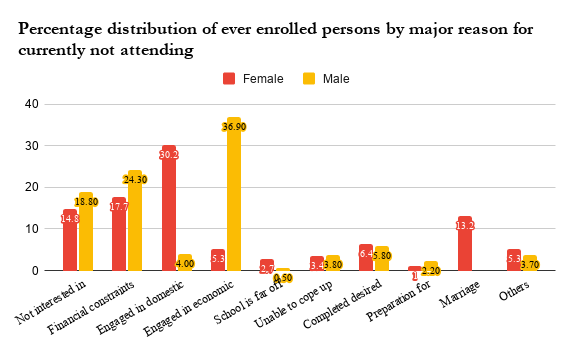 A recent survey by National Statistical Office (NSO) has revealed that around 12.6% of students drop out of school in India, 19.8% discontinued education at the secondary level, while 17.5% dropped out at the upper primary level. As per the survey, a dropout is an “ever-enrolled person” who does not complete the last level of education for which he/she has enrolled and is currently not attending any educational institution. The Government's Right to Education Act and National Policy on Education may have been motivating to provide education to all but it is equally important to analyze the sustainability and efficiency of the education system. Dropout rates are considered to be a great wastage in the education system, not only do many students leave school without acquiring basic skills, but their premature departure represents a significant waste of scarce education resources.Help in domestic work, economic condition, and lack of interest were found to be the topmost cause of discontinuing education. About 30.2% of the girls gave domestic work as the reason for discontinuing education and about 36.90% of boys left studies because they had to support their families. It becomes especially difficult for girls to continue studying because of concerns about their safety. They face sanitary problems due to poor school facilities ultimately forcing them to stay back at home. Considered to be a liability, many girls are imposed to stay back at home, or are forced to get married at an early age (13.2%).
Many children believe that there is no point in studying if they have to do the same job as their parents, thus they leave school at primary level itself. More than 30% of children involved in the survey showed a lack of interest in studies, they preferred to drop out because whatever was being taught in schools barely intrigued them. India is also dealing with the problems of inclusion and equality, children from the marginalized sections of the population, or with physical disability/ health issues have to leave schools when they face hostile behavior from their peers.t is recommended that the government conducts awareness camps in cities, towns, and villages to expose the hazards of illiteracy and unemployment. National Education Policy 2020 has mentioned two initiatives that will be undertaken to curb the problem. The first is to provide efficient and sufficient infrastructure to all students and the second is to set up alternative and innovative education centers for the children of migrant laborers. These are vital steps to ensure that children have access to safe and engaging school education as well as bring back the ones out of school. A dropout early warning system enables schools to identify students who are at risk of dropping out of school, and to focus on individuals who struggle to perform well. Schools should practice innovative teaching methods to draw students towards education and spark interest in them. Digital learning strategies can be used to provide education in the confines of their homes, students can access free educational content through smart-phone applications or YouTube provided by different institutions.
Education enables a person to achieve a better job or means of self-employment, and climb out of intergenerational poverty. It cultivates cultural values and beliefs in the child. Once the awareness to send students regularly to the school continues, slow but sure results will follow.
A recent survey by National Statistical Office (NSO) has revealed that around 12.6% of students drop out of school in India, 19.8% discontinued education at the secondary level, while 17.5% dropped out at the upper primary level. As per the survey, a dropout is an “ever-enrolled person” who does not complete the last level of education for which he/she has enrolled and is currently not attending any educational institution. The Government's Right to Education Act and National Policy on Education may have been motivating to provide education to all but it is equally important to analyze the sustainability and efficiency of the education system. Dropout rates are considered to be a great wastage in the education system, not only do many students leave school without acquiring basic skills, but their premature departure represents a significant waste of scarce education resources.Help in domestic work, economic condition, and lack of interest were found to be the topmost cause of discontinuing education. About 30.2% of the girls gave domestic work as the reason for discontinuing education and about 36.90% of boys left studies because they had to support their families. It becomes especially difficult for girls to continue studying because of concerns about their safety. They face sanitary problems due to poor school facilities ultimately forcing them to stay back at home. Considered to be a liability, many girls are imposed to stay back at home, or are forced to get married at an early age (13.2%).
Many children believe that there is no point in studying if they have to do the same job as their parents, thus they leave school at primary level itself. More than 30% of children involved in the survey showed a lack of interest in studies, they preferred to drop out because whatever was being taught in schools barely intrigued them. India is also dealing with the problems of inclusion and equality, children from the marginalized sections of the population, or with physical disability/ health issues have to leave schools when they face hostile behavior from their peers.t is recommended that the government conducts awareness camps in cities, towns, and villages to expose the hazards of illiteracy and unemployment. National Education Policy 2020 has mentioned two initiatives that will be undertaken to curb the problem. The first is to provide efficient and sufficient infrastructure to all students and the second is to set up alternative and innovative education centers for the children of migrant laborers. These are vital steps to ensure that children have access to safe and engaging school education as well as bring back the ones out of school. A dropout early warning system enables schools to identify students who are at risk of dropping out of school, and to focus on individuals who struggle to perform well. Schools should practice innovative teaching methods to draw students towards education and spark interest in them. Digital learning strategies can be used to provide education in the confines of their homes, students can access free educational content through smart-phone applications or YouTube provided by different institutions.
Education enables a person to achieve a better job or means of self-employment, and climb out of intergenerational poverty. It cultivates cultural values and beliefs in the child. Once the awareness to send students regularly to the school continues, slow but sure results will follow.
How does friendship affect education?
Peer relationships can also help children learn to control their emotions and respond to others appropriately. Better grades are also among the perks of friendships, as several studies have shown that socially active students often have better academic outcomes at school.Anxiety. A very common reason for this difficulty is that many people experience some degree of anxiety when meeting new people. This anxiety stems from a fear of being rejected or judged by others
Look for people who have the same hobbies as you. You’re more likely to be friends with someone if you have something in common with them. Try to find clubs or groups based on your favorite hobbies, then join them to meet like-minded people.[1] Also, pay attention to people who spend their free time doing the same things you love to do.[2]
If you love to draw, for instance, you could register for an art class, attend art shows, or look for people who are doodling during math class.
If you’re a passionate reader, join a book club, go to public readings, or strike up a conversation with someone who carries novels around with their textbooks.
Ask your favorite teachers if they can recommend any academic clubs for you to join! These can include debate teams, clubs for entrepreneurs, or a math quiz team.

Spend time around people who show kindness. Finding someone who will treat you well and support you is more important than popularity. Avoid spending time with people who talk bad about others or put them down. Instead, look for people who invite others to sit with them at lunch, who encourage others when they speak up in class, or who are always willing to help when someone needs a hand.[3]
When you’re around someone, you should feel comfortable acting like yourself around them. A friend should never make you feel bad for being who you are.
You may be interested in befriending some of the most popular people in school, but if they are disrespectful to you or to others, they probably won’t be a true friend.
You should feel like the other person supports and respects you.Make new friends through your current friends. If you already have a few friends but you’re looking to meet more people, try getting to know the other people your friends know. If you don’t have a chance to hang out during the school day, try setting up a group event after school or on the weekends. This can be as informal as walking home together, or it can be a planned activity everyone can participate in.[4]
For instance, you could have your friends start meeting once a week at a local pizza place after school. Each week, encourage your friends to invite as many of their mutual friends as they want. By making it a regular occurrence, you can build new friendships gradually.
You could also attend group events like flag football games or even study groups to meet new people.What are the negative effects of friends?
However, not all friendships are beneficial. Some are toxic and stressful. A bad friend can be many things, but, typically, they lead to mental and emotional fatigue or a lack of general well-being. Research shows that negative or overly-aggressive social interactions can lead to increased inflammation within the body.Why is it so hard to make friends as a teenager?
Sometimes it's a jealousy situation, sometimes it involves peer pressure or fear, and sometimes it's a popularity contest. Teens feel shunned by former friends, and they can't seem to get the relationship back on track. Teens have a hard time making new friends because they are not sure who is trustworthyThe reasons range from thinking “I'm too busy” or “I don't know how to start a conversation” or “she's has too many friends already” to experiencing social anxiety. We've all faced many moments in our lives where we've wanted to make a new friend and simply didn't have the time, tools, or confidence to make it happen.
The beginning of the school year can be a difficult time for students. Evidence suggests that the stress may lead to an initial reduction in grades and problems with self-esteem and attitudes towards teachers. But there are steps teachers can take to make things easier. Ideally, some work to help minimise this would have already happened in the weeks and months leading up to the start of the school year – useful strategies (pdf) include taster days, giving out clear information to set expectations, and using some of next year’s material in advance. However, there may be some students who struggle to adapt. So what are some strategies teachers can use once the year has begun?Find out what’s causing their stress For younger students, the biggest worries about starting secondary school include making friends, finding their way around a new environment, and having to establish multiple teacher-student relationships. Research suggests that this is one of the most stressful transitions for students during their education. Older students obviously have different worries, with social status, for example, being more of a focus for teenagers. By paying close attention to students, teachers can better understand them and guide them towards more appropriate strategies. Helping students to develop a “sense of belonging” at the school is very important for both their wellbeing and achievement, and the quality of the teacher-student relationship is central to this. Remove ambiguity Let’s try a quick experiment. Imagine a scenario where I ask you a series of questions, and there are two possible outcomes to you getting the answers wrong: a) I will definitely give you a mild electric shock, or b) I may give you an electric shock. Which do you find more stressful? If you chose option two, you’re in good company. Recent research from University College London found that those in the uncertain scenario experienced more stress. It turns out that it’s not the worst-case scenario that worries us the most – it’s the not knowing. If we want to help students transition better between school years with less stress, we have to reduce uncertainty. Be explicit about what is and isn’t acceptable behaviour – making sure you include a fair amount of repetition to ensure the messages get through – and talk clearly about good work habits and expectations. Provide both challenge and support Environments that help to foster resilience need to be high in both challenge and support. Too much challenge and no support results in excessive stress, burnout and isolation, while too much support but not enough challenge can lead to complacency and boredom. A study of university students found that those who were able to keep a sense of perspective coped better with change. The trick, then, is to remind students of the big picture, ie that everything will turn out ok, while also giving them a short-term strategy to focus on, ie what they should do next. It’s also important to encouraging support networks, to help individuals manage stressful situations.Fostering a growth mindset Researchers from Columbia University and Stanford University tracked teenagers over two years and found evidence to suggest that a student’s mindset (pdf) affected how well they managed these transitions. Those with an incremental or growth mindset were more likely to get higher grades, take on learning goals, value effort, and adopt positive coping strategies and were less likely to feel helpless than students with an entity or fixed mindset.Talk with your child’s school and/or medical or professional provider to consult on what makes the most sense to support your child and family in the transition back to school. Each child is unique, and parents can adapt ideas to the individual needs of their children and family. Provide developmentally appropriate and honest information regarding the beginning of the school year to help students understand what to expect. It is important to leave time for children to ask questions. When adults remain calm in the conversation, while offering information about successfully transitioning back to school, they can help children gain an increased sense of control. It is best not to overly focus on the news or unnecessary details that might cause increased distress to children. In general, with younger children, brief descriptions (with accurate information) are helpful. Children will respond to your emotions. Offer love and reassurance and remind children that adults, including their teachers and parents, are working to keep children safe. Listen to children’s questions and concerns. Remember that young children might also communicate through play. If children return to in-person school, they will need to be taught new routines regarding physical distancing, hygiene, wearing masks (when required), sharing, etc. It will be important that these new social expectations are taught and reinforced with patience and care. Parents may communicate with the school to understand the new expectations so that they can also have discussions and/or practice at home as needed. For example, parents might practice wearing masks or hand-washing at home. Social stories, books, comic strips, and role-playing that model and educate about the new social routines may also be useful ways to reinforce new school expectations at school and at home. Connecting with the school and reading school communications can also help parents reinforce expectations with common words/phrases in both the home and school settings, when appropriate, so that children are better able to connect concepts. For example, if the phrases “social distancing” or “hygiene” are used in the school setting it might be helpful to use the same words at home when reinforcing expectations regarding the new routines.
A procedure is not a discipline plan. Neither is a procedure a threat, a rule, or an order. A procedure is simply a method or process for how things are to be done in the classroom. Since a PROCEDURE is how you want something done, it is the responsibility of the teacher to have procedures clearly stated.Why procedure is important in teaching? Why is it important to teach classroom procedures? Classroom procedures are important to help save time and resources so teachers can concentrate on student education. These methods provide direction so teachers can focus on teaching and students understand what's expected of theClear communication about expectations is especially important in schools. While teaching styles and classroom rules may differ between teachers, the basic guidelines should be consistent. This helps unify the school and make sure parents and students know what to expect. It also helps create an effective environment for learning, where students and staff can focus on lessons, rather than getting caught up in arguments over things like attendance or clothing. School policies and procedures codify these expectations, so everyone is on the same Attendance policy In the U.S., school attendance is a matter of law. Most states require children to begin school at age 6, and attend school for 180 days each year until they reach the age of 16, 17, or 18. While parents are ultimately responsible for getting their children to school, state and federal laws require schools to keep attendance records. Therefore, school policies and procedures on attendance have to make expectations abundantly clear to parents, students, and staff. The state or local school board establishes many of the specific attendance guidelines. But handbooks for parents and students should include clear, jargon-free language on the benefits of full attendance – the “why” behind the policy.Dress code School dress codes can be tricky. In recent years, there have been several protests over school dress codes that are seen as sexist or unfair. Schools can avoid such controversy by creating clear dress code policies that apply to the entire student population. They must not target one particular group of students, or be enforced in a way that could be seen as discriminatory against students of a particular race, religion, political belief, or gender identity. School policies and procedures about the dress code should be specific and objective. For example, if the dress code prohibits “gang-related” apparel, it should specify what that means. If the policy uses words such as “revealing,” “inappropriate,” or “disruptive,” it should define them or give examples. Creating and distributing dress code policies will ensure that students understand expectations. They will know administrators aren't singling them out. Clear policies will also save teachers from having to subjectively decide whether a student’s clothing counts as “revealing,” which can be awkward.
Low motivation can be a common symptom of depression, anxiety, and other mental health issues. You can practice self-help and self-care as much as you can, but you may find that seeking professional help is more helpful for your emotions. Online therapy is beneficial, especially during the COVID-19 pandemic
Students are demotivated by the structure and allocation of rewards. Students do not perceive the classroom climate as supportive. Students have other priorities that compete for their time and attention. Individual students may suffer from physical, mental, or other personal problems that affect motivation.What are the effects of lack of motivation?
The effects of poor motivation in the workplace are well-attested: higher employee turnover, lower levels of engagement, poor communication, and diminished productivity are just a few of the issues that may proliferate and lead to your workplace become a toxic environmentMotivation should be seen as a very important factor in the learning process. The motivated student has the inner strength to learn, to discover and capitalize on capabilities, to improve academic performance and to adapt to the demands of the school context.Students are demotivated by the structure and allocation of rewards. Students do not perceive the classroom climate as supportive. Students have other priorities that compete for their time and attention. Individual students may suffer from physical, mental, or other personal problems that affect motivation.
You could be feeling the effects of difficulties in your family or the world at large. Maybe you're having a hard time focusing or feel like your goals are too far away. It's normal to feel unmotivated sometimes, and you'll deal with that feeling off and on throughout your whole lifeA relative autonomous or self-determined motivation leads to a good study strategy and high study effort, which leads to better academic performance, i.e. the study strategy mediates the influence of motivation on academic performanc
Students are demotivated by the structure and allocation of rewards. Students do not perceive the classroom climate as supportive. Students have other priorities that compete for their time and attention. Individual students may suffer from physical, mental, or other personal problems that affect motivationBecause of the high level of thinking that is required, students must have a basic understanding of what is going to be taught so they can better UNDERSTAND, USE, and CONSTRUCT knowledge! If students aren't motivated, it is difficult, if not impossible, to improve their academic achieve- ment, no matter how good the teacher, curriculum or school is. Moreover, unmotivated students can disengage other students from academics, which can affect the environment of an entire classroom or schooThose are: the lack of student teachers knowledge on the student field; the lack of supervision time; the confusion in selecting teaching media. In order to develop the material to be achieved by the student easily, it is important to have a background knowledge related to the vocations that the student teacher taught.
Image result for poor time management in school We usually fail to manage time by not planning ahead, not setting priorities, not having clear goals, and procrastinating.These are the most common signs of poor time management. They cause a series of mistakes that we’ll discuss later in the article (as well as offer solutions, of course). Easily distracted It’s hard to find a space that is completely free of distractions, but we can do our best to optimize our working space to be as distraction-free as possible. The first step is to find out what distracts you the most. Are those notifications on your phone? Talking to your coworkers? Street noises? After you figure out what it is, it will be easier to manage and avoid it. Poor punctuality We’ve all been stuck in the traffic, or our alarm didn’t go off for some reason. We’re human and accidents happen, but being constantly late is something different. It’s disrespectful to others and their time. As Anna Musson, the etiquette expert, told The Huffington Post Australia, “There are a multitude of reasons as to why [someone is late], but the overriding reason is it suggests deep down you think your time is more valuable than others.” Few minutes of waiting here and there tends to add up quickly, which results in a lot of wasted time. Missing deadlines Just as being late, if it happens rarely and for a good reason, it can be filed under “things happen”. On the other hand, frequently missing deadlines will seriously impair your professional reputation. It’s important to be able to rely on the people you work with and trust them that they’ll do their part, so you can do yours. If people can’t rely on you, they won’t want to work with you. If you happen to miss deadlines often, you should try to figure out why – the most common reasons are procrastination, being unable to organize your time effectively, or because you should delegate and outsource more. Always rushing Do you feel like you’re constantly in a rush? There never seems to be enough time to do everything you’ve planned? It could be either because you’re waiting until the last minute or because you have too many things on your plate, so you’re struggling to complete all the tasks. Whichever one it is, it’s both stressful and negatively affects the quality of your work. Plan out your day in advance to make sure you have enough time and energy for everything. You can either use a time management app or a good old to-do list for that purpose. Burnout Perhaps the worst sign of poor time management is your health being at risk. Burnout shows itself in a variety of symptoms: from physical (shortness of breath, dizziness, weakened immune system, among others) to emotional and behavioral (mental exhaustion, loss of motivation, feeling helpless and trapped, etc). The best way to combat it is to give yourself a break. Schedule time to rest and enjoy life outside work.Stress. Poor time management causes us to always be in a rush, which results in a lot of additional stress. Whether you know you have to do something but you’re not doing it, deadlines are approaching and you are not even close to being done, or you have to squeeze 2 weeks’ worth of work into a day or two – it can all be avoided by organizing your time better. Always being late. Poor punctuality is one of the most frequent problems caused by bad time management. Time slips away easily, but being late makes people perceive you as unreliable. Ruining your professional reputation. No one’s ideal coworker is someone who’s always late and doesn’t respect deadlines. Most people understand if it happens once and you have a good reason, but if you have no concept of punctuality whatsoever, you’ll be labeled as unprofessional. Low productivity and poor quality of work. When you’re leaving everything for the last minute, it’s not very likely that your work will be of great quality, as you’ll rush to get it done. This negatively affects your performance and your results. Start on time and you won’t have to sacrifice quality for speed. Having too much on your plate. If you don’t have a clear idea of 1) the time you need to complete something and 2) the time you have available, you are in danger to overextend yourself. Only accept projects that you’re completely sure you’ll be able to complete successfully. Poor work-life balance. If you don’t have a set schedule, you’re probably always working, but rarely engaging in deep work. This results in a poor work-life balance, which can affect your mental health.
Short and long term action plans for problems identified
- Curriculum - The curriculum has improved because of the competition in different education boards and among the states.
- A shift in focus from content to concept - Understanding the concept is focused rather than just grasping the information and memorizing it. It is believed that conceptual understanding will make students better at solving problems.
- Engaging students in learning - Students can talk and share their perspectives on topics rather than just teachers speaking for hours. Hence more focus is on learning rather than teaching.
- Active learning - Earlier, students learned passively listening to teachers and just answering the questions. Nowadays, a student is effectively involved in active learning. The student asks questions to know more than what the teacher is teaching. Asking questions to solve doubts assures deep learning and better grasping of the subject conceptually.
- Discipline - School disciplinary practices have changed globally. Rather than the punishments, the focus is now shifted to learning from the wrong action and making students realize what went wrong. Learning ensures repairing the student-teacher relationship and making them ready for life challenges.
- Games to play - Playgrounds now involve games that focus on balance and coordination. In addition, adventure playgrounds are installed to generate gross motor skills rather than the initial swings and see-saws.
- Technology - The location of the classrooms has now changed from the conventional 4-walled room to the laptops, tablets, and mobile phones. Students not just learn in class but can learn remotely from whosoever they want to. Lessons are taught and recorded so that the students can revisit to learn effectively.
- Learning Resources - Students are taught in a digital classroom using illustrations and animations to clear the concept. Initially, books, blackboards, and notes were the learning resource that has now been shifted to the exciting new technologies. 24
- Assessments - Assessments have evolved from the conventional ways of writing answers to the questions on the test papers to the presentations, performing a play, or creating a video explaining the topic. Involving in creative activities engages the student in the learning process along with the enjoyment.
- Learning to read and write-Learning to read and write is almost the same. Students are taught alphabets, words, pronunciation, spelling to be able to read and write. The only difference is how these are taught. The more interactive way offers better learnin
The education system in India is very different from the education system in the other countries. Often, the Indian education is criticised for not providing a diverse platform to students where they get an opportunity of learning practically. The circumstances of a country play an important role in the foundation of an education system as well as shaping that education system in the coming years. The surroundings, the source, the process and various other factors are also essential. While the roots of the Indian education system originate from the British education system itself, it’s consequential state resulted from the lack of essential infrastructure and funds. Today, while many definitive measures are being taken to improve the state of the Indian education, there is still a long way to go to achieve the standard of education as it is in some of the leading nations of the world. Until then, the path of abroad education can help Indian students get an education that is at par with their peers in an international workforce.
The education systems in Indian and abroad vary drastically on a majority of aspects. As a student, if you too, are looking to choose between Indian and global education, a few determining factors to consider are:More often than not, it is true that top international recruiters value education at global
institutions due to the benchmark that these institutions have set in the past years.
Therefore, the students from these universities get a head-start in their careers. The
standard of education at Indian universities is not that remarkable, and hence, there are
limited opportunities for the students. The admissions to top notch colleges are highly
competitive with limited seats. Along with these, there are also many other factors like
environment, lifestyle, exposure, and more which differentiates foreign education from the
Indian education. For us as Indians, it's a matter to take these things as a challenge and
work on it effectively to make it a great nation for an excellent education in future.
The factors stated above can help you to understand and make an informed decision to
choose your future. Studying overseas does give new experiences, but ultimately, you
should consider the higher education option in which you find your utmost interest being
fulfilled. Remember, education is a learning process in which we grow and develop our
skills for our future.
1. Academics Getting a foreign degree abroad gives you the immense academic strength and difference in each and every individual person. Foreign universities emphasize practical learning rather than theoretical learning, so that the students gain fruitful knowledge and hand-on experiences.
2. Work with study Students mainly plan International work experience along with the foreign degree which is an added advantage to the resume. In most of the countries international students can work with their Students visa. So students can study and work, and gain a wonderful experience altogether. 26
4. Research opportunities: The research opportunities available abroad are so distinctive, innovative, and ultra- advanced and so the students gain a fruitful experience. Students do not get enough resources and infrastructure from the Indian colleges but as in foreign colleges the students are provided with new techniques, equipment and resources.
5. Course options Studying internationally provides the students with diverse course options and many skill based training. Indian college does not provide different course options whereas foreign college provides you with deeper depth of the study and higher scope of the courses.
6. Communication skills Studying internationally helps the students to communicate in English confidently that will help the students to reach great heights both academically and individually
How to Improve Education System
1.Better Standards:
The policies and programs in the education structure should be developed to aim higher
achievement standards and goals. Standards are formal documents that establish uniform
education criteria, methods, processes, and practices developed through an accredited
consensus process. Standards should be developed based on guiding principles of openness,
balance, consensus, and due process and should be duly established in order to meet
technical, safety, regulatory, societal, and market needs and should also be catalysts for
technological innovation and global market competition. The adoption of standards will
benefit both students and their faculty mentors as they face various challenges and will help
the students understand and assess what they are aiming at and where they are heading.
Education as a sector has a diverse range of potential standards requirements including and
some areas where development of standards will be helpful are; managing student records,
managing research proposals and outputs, using classroom interaction technology, supporting
distance and flexible learning online, providing authentication and authorization services for
managing access to digital resources, detecting plagiarism and using digital assessments.
2. More Accountability:
The institutions, the educators, the managements are the people who provide instructions,
curriculum, and demonstration to the students and thus pave way for results. There should be
an accountability strategy under which the institutions showing remarkable results should be
rewarded and those with poorer results should be penalized. In short, creating accountability
in public or private education is extraordinarily complex. No single policymaker or provider
is responsible for failing students; rather, a complex web of policymakers and providers is
responsible. Some potential ways to strengthen accountability are to strengthen the client's
voice, improve management, provide better information to clients, clarify roles and
responsibilities, and increase incentives and consequences.
3. Parent Involvement:
Overall, research has consistently shown that parental involvement in children’s education
does make a positive difference to pupils’ achievement. Most children have two main
educators in their lives – their parents and their teachers. Parents are the prime educators until
the child attends an early year setting or starts school and they remain a major influence on
their children’s learning throughout school and beyond. The school and parents both have
crucial roles to play. Children achieve more when schools and parents work together. Parents
can help more effectively if they know what the school is trying to achieve and how they can
help. A successful system supports more parent involvement in selecting child education and
learning process. The school plays an important role in determining the levels of parental
involvement in school. Specifically, schools can outline their expectations of parents and
regularly communicate with parents about what children are learning. Also, schools can
provide opportunities for parents to talk with school personnel about parents' role in their
children's education through home visits, family nights, and well-planned parent-teacher
conferences and open houses, seeking regular feedback and suggestions from parents
regarding the school working system.
4. Autonomous Structure:
Some nations are innovative in their quest for the optimal school structure, while others
pursue policies with little deviation from the orthodox model of the local or community
school. Research suggests that moving to a more autonomous school structure generates a
significant improvement in the quality of their pupil intake and a significant improvement in
pupil performance. A successful system supports an autonomous structure to the schools to
freely decide their framework and resources required to meet the same.
5. Adapt to New Technologies:
Educational institutions must adapt to new technologies if they want to remain competitive.
Technology has become an integral part of most students' learning experiences, and
educational institutions must offer the newest technologies. Some benefits of using
information technology in education are; It induces scientific, economic, technological,
information and multicultural literacy and global awareness, promotes inventive thinking,
develops effective communication, induces personal, social, and civic responsibility, and
eventually leads to high productivity. It also gives students a sense of using real-world tools
with effective, relevant, and high-quality results. Students will be drawn to those companies
or institutions that can keep up with changes in technology. The use of updated technology
and equipment will improve the learning experience and will also increase productivity.
6. Curriculum Revision:
There is a need to continuously revise the curriculum for instructional programs in an effort
to meet society’s demands for changing the 2lst century workforce. Determining what these
needs are, how to address them, and how to revise the established curriculum is a challenging
and critical task. This demand for change to meet the needs of a 2lst century educational
program is challenging even for the best educational leaders because society's values and
needs change over time. The world has turned into a global village where new ideas and
information are pouring in a constant stream. It is, therefore, imperative to update our
curricula by introducing the recent developments in the relevant fields of knowledge.
However, the curriculum should be revised on regular basis to keep the students updated with
the current affairs. Sticking to the conventional curriculum will not produce hybrid results.
7. Periodic Assessments:
Periodic Assessment Record of students in academics and non-academics should be
maintained and periodic reports should be communicated to the parents. This will help the
students, teachers, parents, and the public have access to real information. This will create
transparency in the working system and will produce better results.
8. Education Partnerships:
A business–education partnership is involvement between schools and business-industry,
unions, governments, and community organizations. These partnerships are established by
agreement between two or more parties to establish goals, and to construct a plan of action
for the achievement of those goals. Business-education partnerships serve business and
industry by providing activities such as in-service training to employees, use of facilities,
student-directed projects, software development, or marketing research. An educational
institution can forge a mutually beneficial relationship with any number of businesses and
can have other stakeholders including parents, students, and community organizations. This
type of relationship helps both parties achieve their desired learning outcomes by sharing
values and resources.
9. Develop Personalized Learning:
Educational institutions can develop personalized learning to overcome the challenge
presented by standardized learning. Technology has made available a huge number of
educational opportunities and it has become feasible to develop training courses customized
to individual needs and for individuals of any age. Online courses provide students to have
more options for choosing an educational service provider that meets their needs, abilities,
finances, and personal preferences. Educational institutions that want to remain competitive
must accommodate this need for flexibility by offering programs that focus more on
certification and skill attainment. Educational institutions and governments can work together
to promote personalized learning by making it a priority for both students and teachers.
Educators can gather data to help them support learning that's flexible and meets the needs of
all individuals. And teachers must be provided with the tools they need to help all students
succeed.
10. Provide Customized Training:
Employers and educators must provide customized training in order to address the challenge
of adapting to the economy's changing employment needs. Some companies are taking
advantage of this growing market by creating personalized training that directly meets a
company's requirements. Personalized and specialized training can be imparted by way of
training seminars, conferences, home study programs, and publishing excellent books on
contemporary topics. Similarly, there are training providers that specialize only in one
business area, technology, or process. Instead of offering an off-the-shelf solution, the
instructor uses real-life scenarios to deliver training that participants can relate to. This allows
the instructor to address the specific needs of each team he works with. Customized training
can be delivered right at the company's facilities, making it even more effective